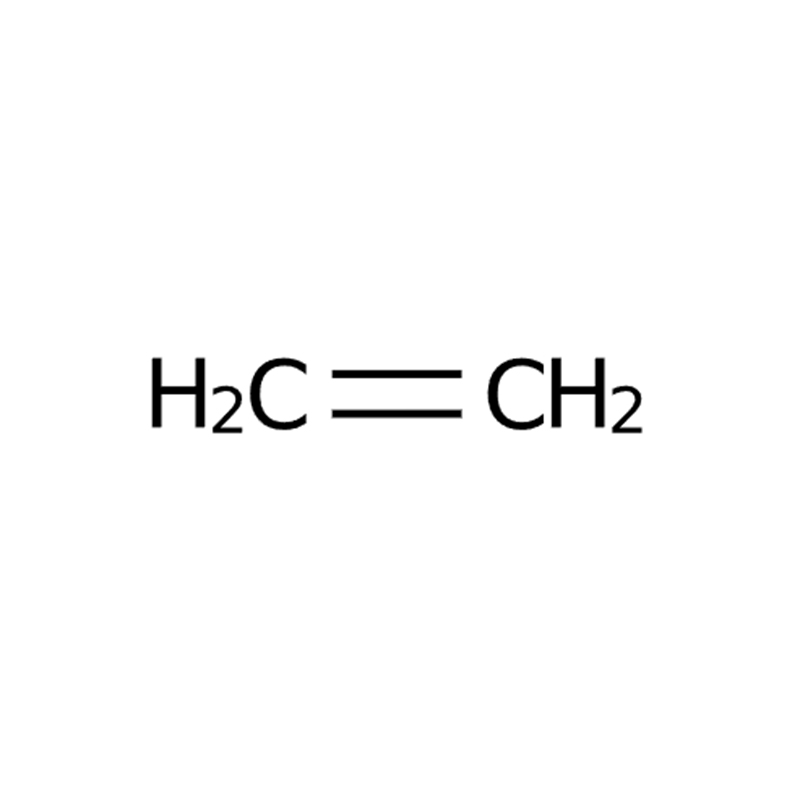
Ethylene is a simple olefin compound consisting of two carbon atoms and four hydrogen atoms, with the two carbon atoms linked by a double bond. Its molecular formula is CH₂=CH₂, making it one of the most fundamental chemical raw materials. It is widely used in the production of synthetic fibers, synthetic rubber, synthetic plastics such as polyethylene and polyvinyl chloride, as well as synthetic ethanol.
Ethylene is also an important feedstock for manufacturing vinyl chloride, styrene, ethylene oxide, acetic acid, acetaldehyde, ethanol, and explosives. In nature, small amounts of ethylene are produced as plant metabolic products, where it can regulate plant growth, promote leaf shedding, and accelerate fruit ripening.
At room temperature, ethylene is a colorless and flammable gas with a melting point of -169°C and a boiling point of -103.7°C. It is almost insoluble in water, slightly soluble in ethanol, and readily soluble in organic solvents such as ether and acetone.
Ethylene Properties
| English Name | Ethylene |
| English Synonyms | Ethylene,Ethene;Ethylene, 99+%6;Ethylene puriss., >=99.95%6 (GC);Ethylene Messer(R) CANGas, 99.98%6;ETHY LENE;Ethylene, compressed.;ethylene refrigerated liquid;Ethylene,high purity |
| CAS Number | 74-85-1 |
| Molecular Formula | C2H4 |
| Molecular Weight | 28.05 |
| EINECS Number | 200-815-3 |
| Melting point | -169°C(lit.) |
| Boiling point | -104 °C(lit.) |
| Density | 0.00126 |
| Vapor density | 0.97 (vs air) |
| Vapor pressure | 35.04 atm (20°C) |
| Refractive index | 1.363 |
| Flash point | -100℃ |
| State | colorless gas |
| Explosion limits | 36% |
| Water solubility | 90.91g/L(25 °C) |
| Freezing point | -169.4℃ |
| Specific heat capacity | Cp(gas): 1.53 J/(g-K), at 25℃ |
| Merck | 133,825 |
| BRN | 1730731 |
| Henry's Law | 5.9×10⁻⁵ mol/(m3Pa) at 25C, Burkholder et al. (2019) |
| Stability | Stable. Highly flammable - note the wide explosion limits. Incompatible with strong oxidizers. Easily forms explosive mixtures with air. |
| InChI | 1S/C2H4/c1-2/h1-2H2 |
| InChIKey | VGGSQFUCUMXWEO-UHFFFAOYSA-N |
| SMILES | C=C |
Ethylene is a key basic raw material in the organic chemical industry, primarily used in the production of polyethylene, ethylene-propylene rubber, and polyvinyl chloride. In early applications, ethylene fumigation was used to accelerate banana ripening. Today, ethylene treatment is widely applied for the ripening of bananas, the removal of chlorophyll from citrus fruits and lemons, and the promotion of tobacco curing.
Ethephon, a liquid ethylene-releasing agent, offers greater convenience and broader applications. In agricultural practices, it is used to promote the ripening of tomatoes, cotton, and tobacco, enabling earlier harvesting, improving product quality, achieving more uniform maturity, and supporting efficient mechanical harvesting.
As one of the most fundamental petrochemical feedstocks, ethylene plays an essential role in the production of synthetic materials. It is extensively utilized in manufacturing polyethylene, vinyl chloride and polyvinyl chloride, ethylbenzene, styrene and polystyrene, ethylene-propylene rubber, and other polymer materials. In organic synthesis, ethylene serves as an important intermediate for producing ethanol, ethylene oxide, ethylene glycol, acetaldehyde, acetic acid, propionaldehyde, propionic acid, and various other basic organic chemical products.